
AboutServicesHair TransplantConcierge MedicineBlogPayment PlansContact Us
Physician-performed hair restoration surgery in Los Angeles, California. Individualized hairline design, careful donor management, and a long-term surgical plan with Vahe Mkhitaryan, MD.
Consultations in English, Armenian, and Russian
A hair transplant moves hair; it does not create new hair. Everything that can be achieved surgically is governed by what the donor area can supply over a lifetime. The evaluation examines the following.
Magnified examination of the scalp to assess follicular units, grouping, and the condition of the surrounding skin.
How many follicular units are present per unit area in the donor region, measured rather than estimated by eye.
The thickness of individual hair shafts, which affects how much visual coverage each graft contributes.
The proportion of thinning, reduced-diameter hairs, which indicates areas that may change over time.
The region of the scalp least likely to be affected by future pattern loss, mapped individually for each patient.
How the pattern may continue, so that today’s plan does not create an unnatural appearance later.
The donor area does not regenerate. It is the true limiting resource in every hair transplant plan.
“The donor area is finite. Responsible donor management means planning for the patient’s next twenty years, not only the next procedure.”
Follicular unit excision describes how grafts are removed from the donor area: individual follicular units are extracted directly, without removing a strip of scalp.
Direct hair implantation describes how grafts are placed: an implanter pen creates the recipient site and sets the graft in one motion.
The two terms are not alternatives to one another. Extraction is FUE; implantation may be performed with an implanter pen or with pre-made recipient sites. The method of placement is selected case by case based on the plan and the characteristics of the scalp.
Not every patient who requests a hair transplant is offered surgery.
A session is generally a full day, commonly in the range of six to eight hours depending on the agreed plan. No completion time is promised in advance; the day ends when the planned work has been carried out properly.
The plan agreed at consultation is reviewed again with you before anything begins.
The design is drawn on your scalp, checked with you in a mirror, and adjusted while you are seated upright.
The donor region is trimmed and prepared, and local anesthetic is administered.
Follicular units are extracted from the mapped safe donor zone and held under controlled conditions.
Sites are created at the planned angle, direction, and depth, region by region.
Grafts are placed according to the design, with single-hair units along the frontal edge.
A meal break and rest periods are part of the day; sessions are not rushed to a fixed clock.
Written aftercare instructions are reviewed with you before you leave, along with follow-up arrangements.
These questions apply to any practice you consider, including this one.
Excellent care and poor-quality care both exist in many locations. The purpose of these questions is to help you compare evaluation, surgical responsibility, continuity, and long-term planning.
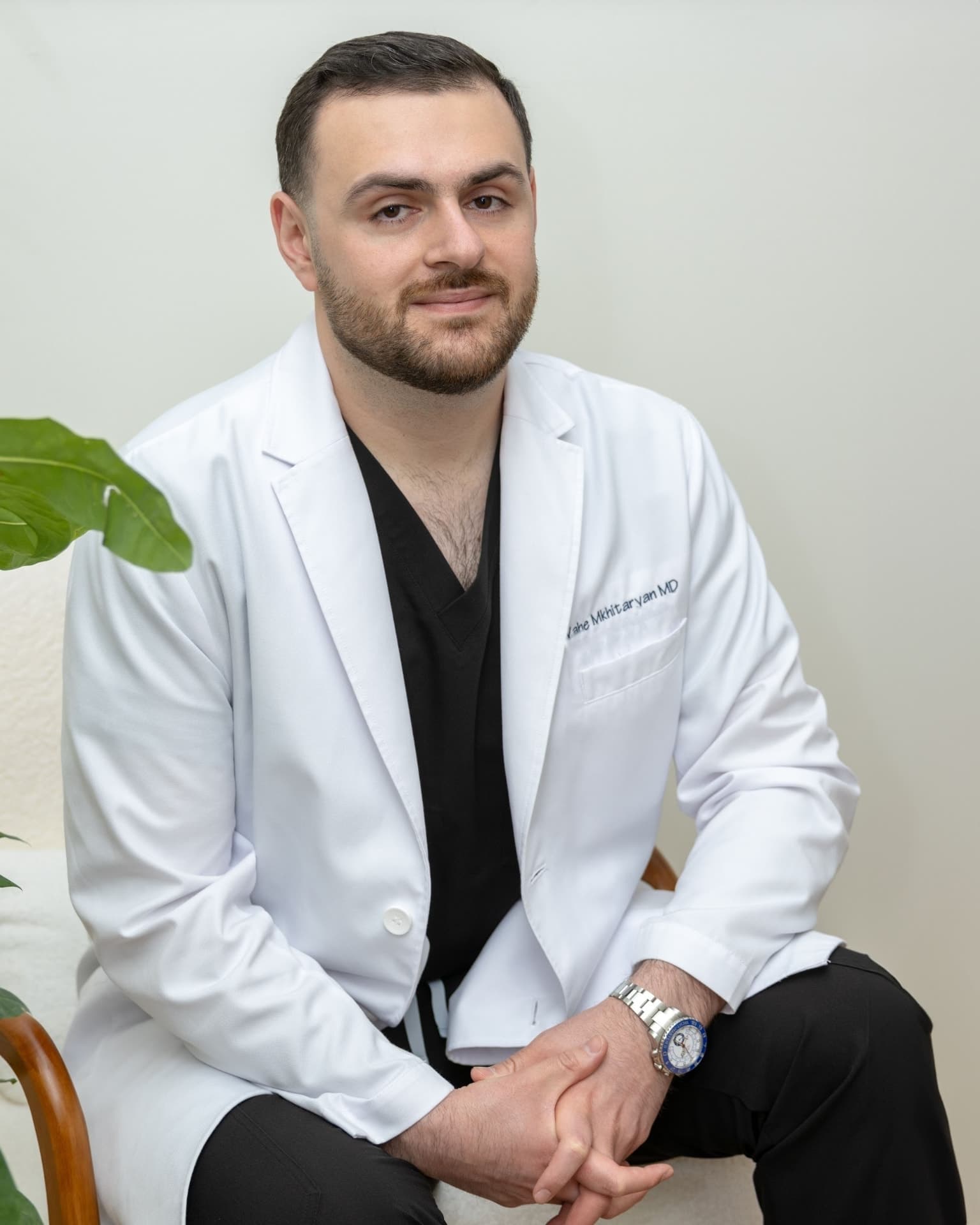
Vahe Mkhitaryan, MD runs a practice focused on hair transplant surgery in Glendale, California. Evaluation, hairline design, and the surgical plan are handled by the physician rather than delegated.
In many practices the surgeon evaluates the patient and designs the hairline, and the remaining surgical steps are carried out by assistants. That is a common model, and it is not always made clear to patients beforehand.
Vahe Mkhitaryan, MD personally performs:
Graft placement is carried out by trained surgical assistants, working to the recipient sites and the plan Dr. Mkhitaryan has created, under his direct supervision.
A surgeon performing the evaluation, the design, the incisions and the extraction personally means longer operative days and fewer procedures in a week. It is a deliberate structure, and it is the reason scheduling can take time.
Training in several settings informs an individualized, physician-led approach to each case. Consultations are conducted in English, Armenian, and Russian.
Procedure pricing is determined at your in-person consultation, after your donor area has been evaluated and an individualized surgical plan has been developed.
Payment plan options are available. Terms, eligibility and application details are listed on the payment plans page. View Payment Plan Options
Cost depends on the number of grafts required, your donor characteristics, the complexity of the procedure, and whether it involves repair of previous work. Because those factors are only established through an in-person examination, pricing is discussed at your consultation rather than quoted in advance. Payment plan options are available.
There is no reliable way to answer this from a photograph. The number depends on your hair-loss pattern, donor density, hair caliber, the area being treated, and how much future loss has to be planned for. A graft estimate is given after an in-person scalp examination.
FUE describes how grafts are removed from the donor area. DHI generally describes a method of placing them, using an implanter pen rather than pre-made recipient sites. They are not competing procedures — a patient may have FUE extraction with DHI-style placement. Which approach is used depends on the surgical plan, the area being treated and your hair characteristics.
This is determined mostly by design decisions rather than by technique. Hairline position, the angle and direction of each incision, the use of single-hair grafts along the frontal edge, and a density plan that accounts for future loss are what decide whether a result reads as natural. A hairline also has to suit your facial proportions, your age and your ethnic background.
Dr. Mkhitaryan personally performs the consultation, hairline design, local anesthesia, recipient site creation and FUE extraction. Graft placement is carried out by trained surgical assistants working to the sites and plan he has created, under his direct supervision.
Candidacy depends on donor density, how stable your hair loss is, the pattern you are likely to follow, and whether your expectations can be met with the donor supply available. Not every patient who requests surgery is offered it. In some cases medical treatment first, or no surgery at all, is the appropriate recommendation.
Most of the visible healing — redness, swelling and crusting — resolves over the first one to two weeks, though this varies between individuals. Specific activity and return-to-work guidance forms part of your written postoperative instructions, since it depends on the extent of the procedure.
Transplanted hair typically sheds in the weeks following the procedure before regrowth begins. Growth then develops gradually over many months and continues to mature for a year or more. Timelines vary between individuals and no specific schedule can be guaranteed.
Yes. A transplant redistributes existing follicles; it does not stop the genetic process affecting your remaining hair. This is why the surgical plan accounts for likely future loss, and why treatment to help preserve existing hair is discussed separately.
Yes. Consultations and all pre- and postoperative care are available in Armenian and English.
Tell us how to reach you and our team will contact you to schedule an in-person evaluation with Vahe Mkhitaryan, MD.
Vahe Mkhitaryan, MD — California Medical License #A180405
The content on this page is provided for general educational purposes only. It does not constitute medical advice, does not establish a physician-patient relationship, and is not a substitute for in-person evaluation by a qualified physician. Individual results vary.